06
Commercial / Multi-Family Housing
DECEMBER 2025
PROJECT DESCRIPTION
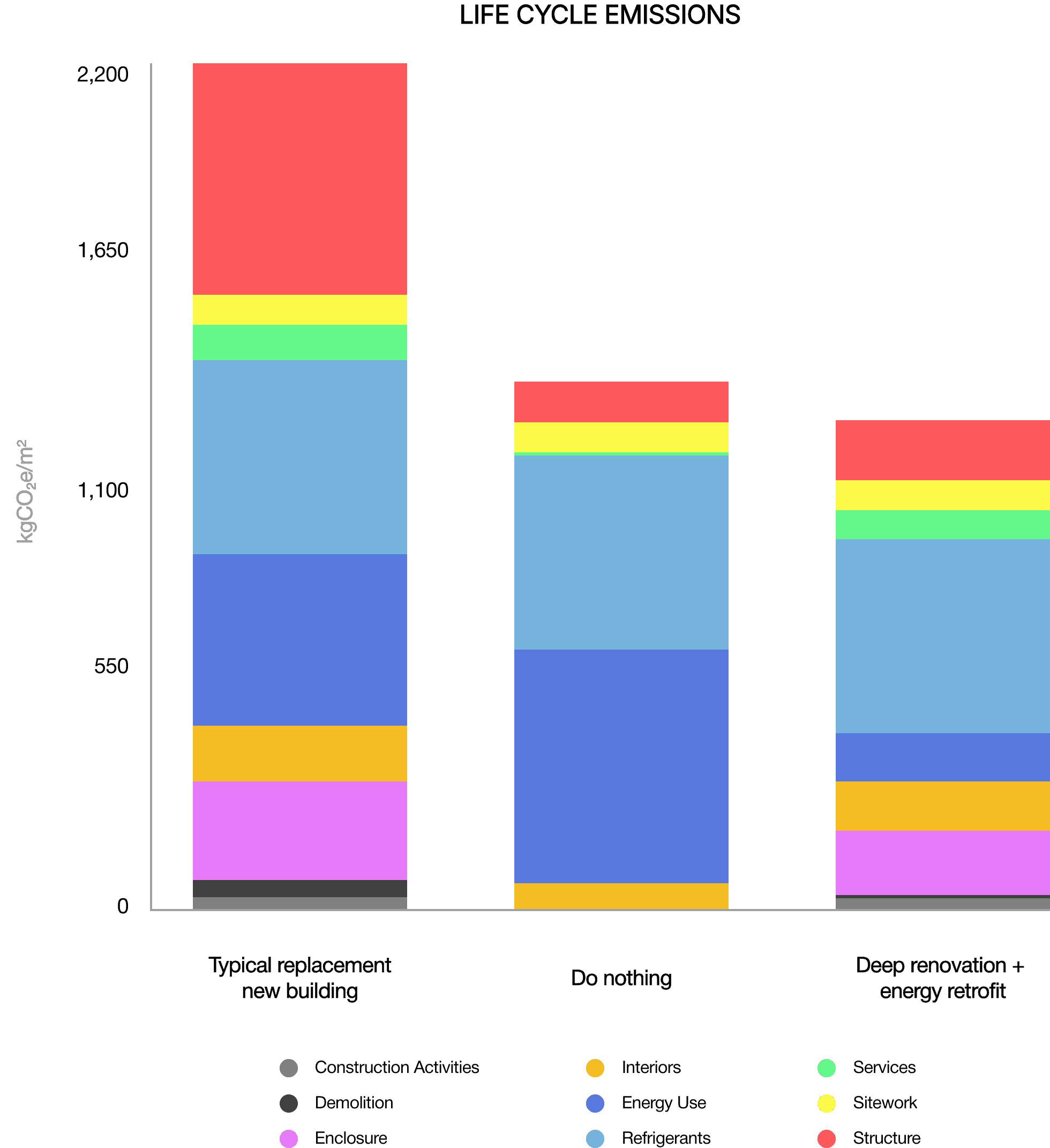
Adaptive-A10 investigates whether selective reuse can outperform full replacement in both carbon and performance. By preserving the structure, foundations, and most floor assemblies, the project minimizes demolition and avoids unnecessary embodied carbon. The study demonstrates that a targeted retrofit can achieve a 41% lower whole-life footprint while improving usability and operational efficiency.
PROJECT TYPE
CoMMERCIAL / MULTI-FAMILY HOUSING
Adaptive Reuse & Redevelopment
YEAR
2025
CONTRIBUTION
SITE ANAlYSIS
ARCHITECTURAL DESIGN
SITE
PORTLAND,
DOWNTOWN
SITe Analysis
Site Summary
Adaptive-A10 sits inside the Sellwood-Moreland neighborhood, positioned along a historic commercial corridor connecting Portland’s inner southeast districts. The site is surrounded by a walkable urban fabric, low-rise commercial buildings, and residential blocks.
URBAN CONTEXT
The site benefits from proximity to Sellwood’s retail district, the Willamette riverfront, neighborhood parks, and light industrial zones to the east. Its context supports adaptive reuse targeted at local commercial tenants and neighborhood-serving programs.

Urban Context Map
ZONING OVERVIEW
• Zoning: CM2 — Commercial/Mixed Use 2
• Height limit: 45 ft
• FAR: 2.5:1
• Uses: Retail, services, residential, mixed employment
• Implication: Supports adaptive reuse without requiring demolition.
SITE NOTES
• Sellwood–Moreland neighborhood
• Corner-lot commercial frontage
• Surrounded by low-density mixed-use
• Strong pedestrian flow along Milwaukie Ave
Spatial Layout
BASEMENT
01 STORAGE RETAIL A
02 STORAGE
03 STORAGE
04 CIRCULATION
05 STORAGE RETAIL B

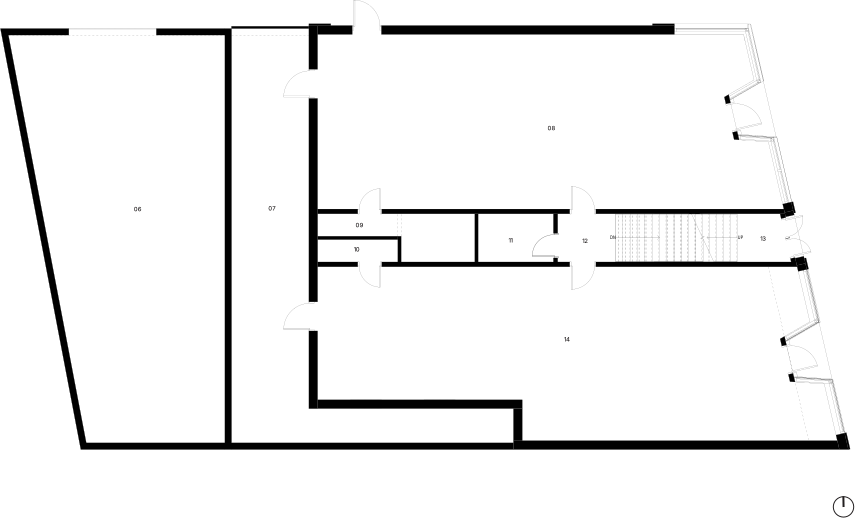
GROUND FLOOR / COMMERCIAL
06 RETAIL BACK-OF-HOUSE STORAGE A
07 RETAIL BACK-OF-HOUSE STORAGE B
08 RETAIL SPACE A
09 CLOSET
10 ELECTRICAL PANEL ROOM
11 WASH ROOM
12 BASEMENT ACCESS
13 RESIDENTIAL ENTRY
14 RETAIL SPACE B
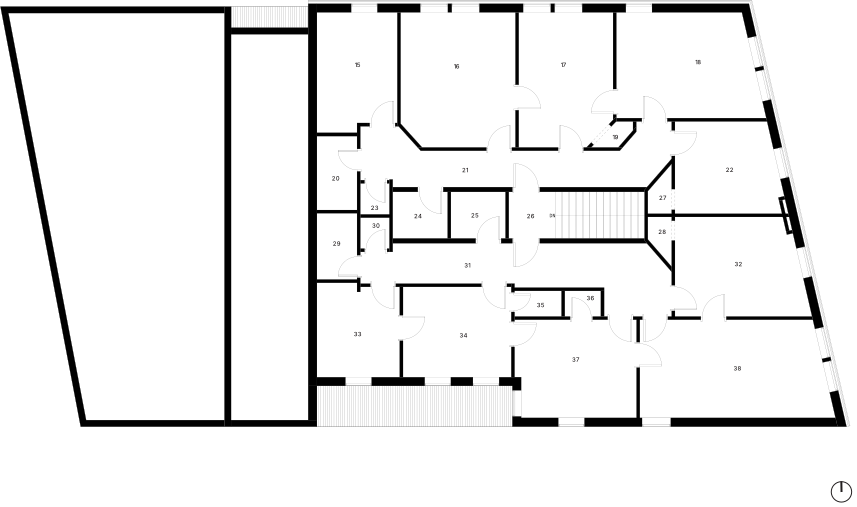
UPPER FLOOR / UNIT A
15 BEDROOM A
16 BEDROOM B
17 LIVING AREA A
18 LIVING AREA B
19 CLOSET
20 BATHROOM
21 HALLWAY
22 KITCHEN
23 STORAGE / MECHANICAL
24 LAUNDRY ROOM
25 LAUNDRY ROOM
UPPER FLOOR / UNIT B
26 ENTRY
27 PANTRY
28 PANTRY
29 BATHROOM
30 STORAGE / MECHANICAL
31 HALLWAY
32 KITCHEN
33 BEDROOM A
34 BEDROOM B
35 CLOSET A
36 CLOSET B
37 LIVING AREA A
38 LIVING AREA B
ELEVATION ANALYSIS
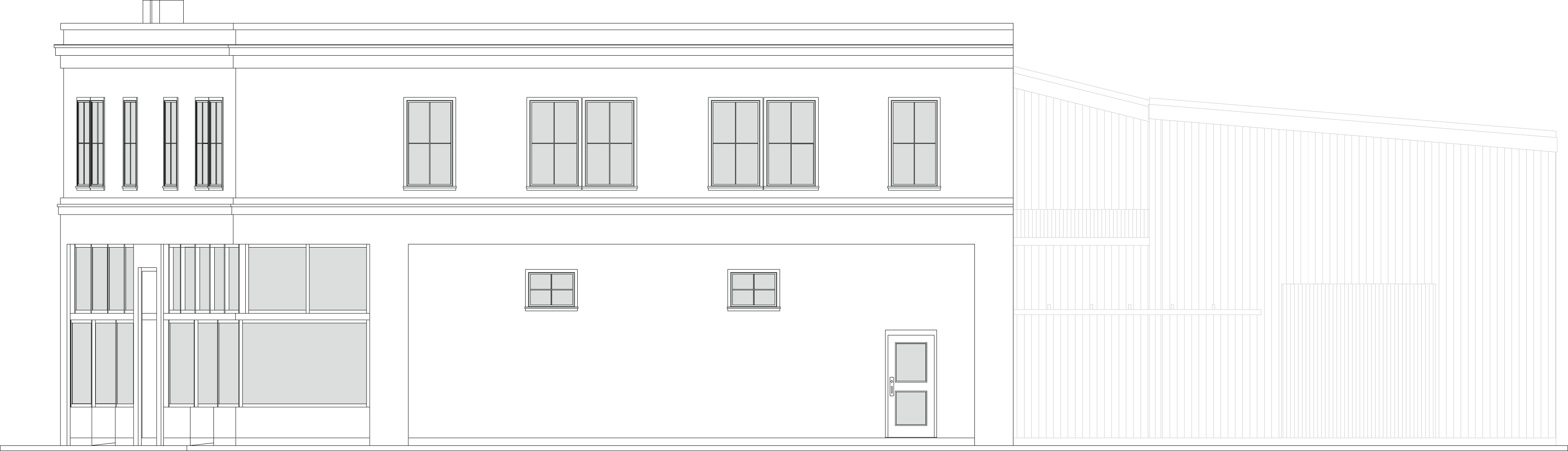
SOUTH ELEVATION
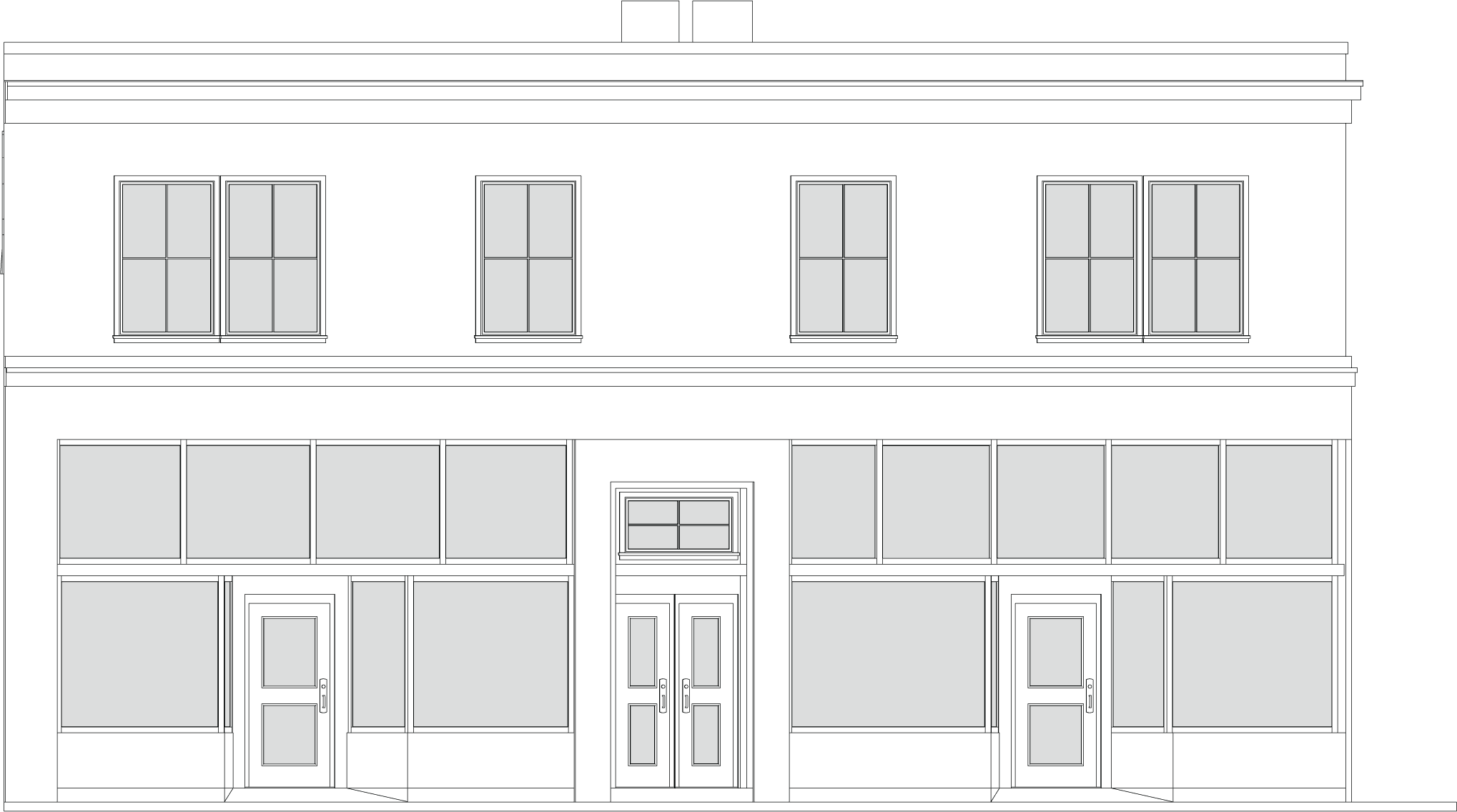
EAST ELEVATION
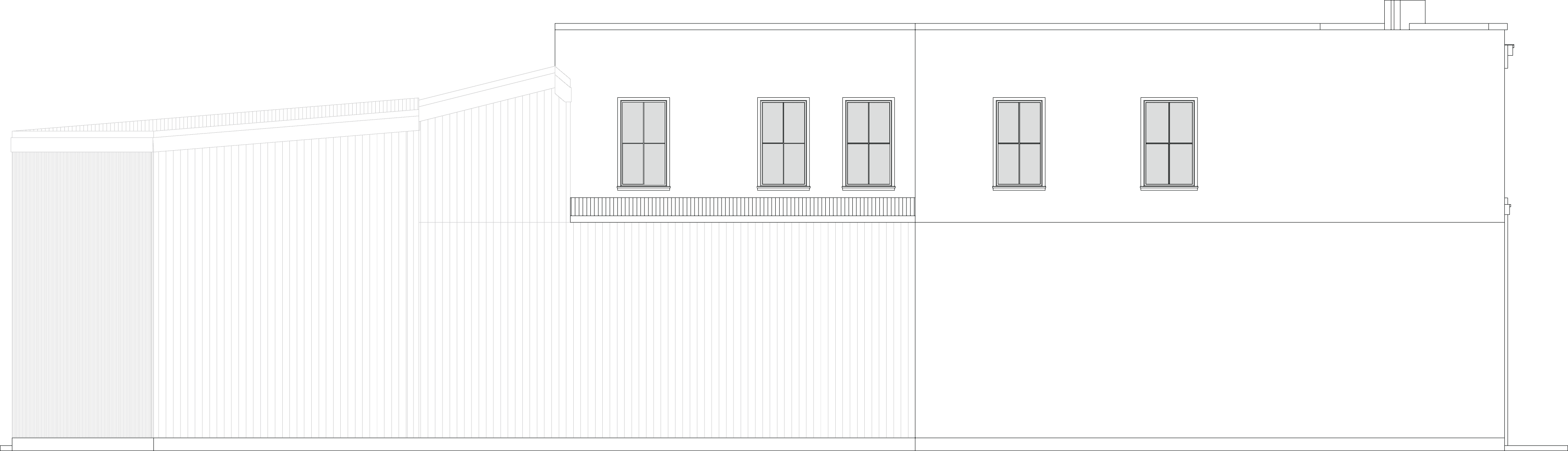
NORTH ELEVATION
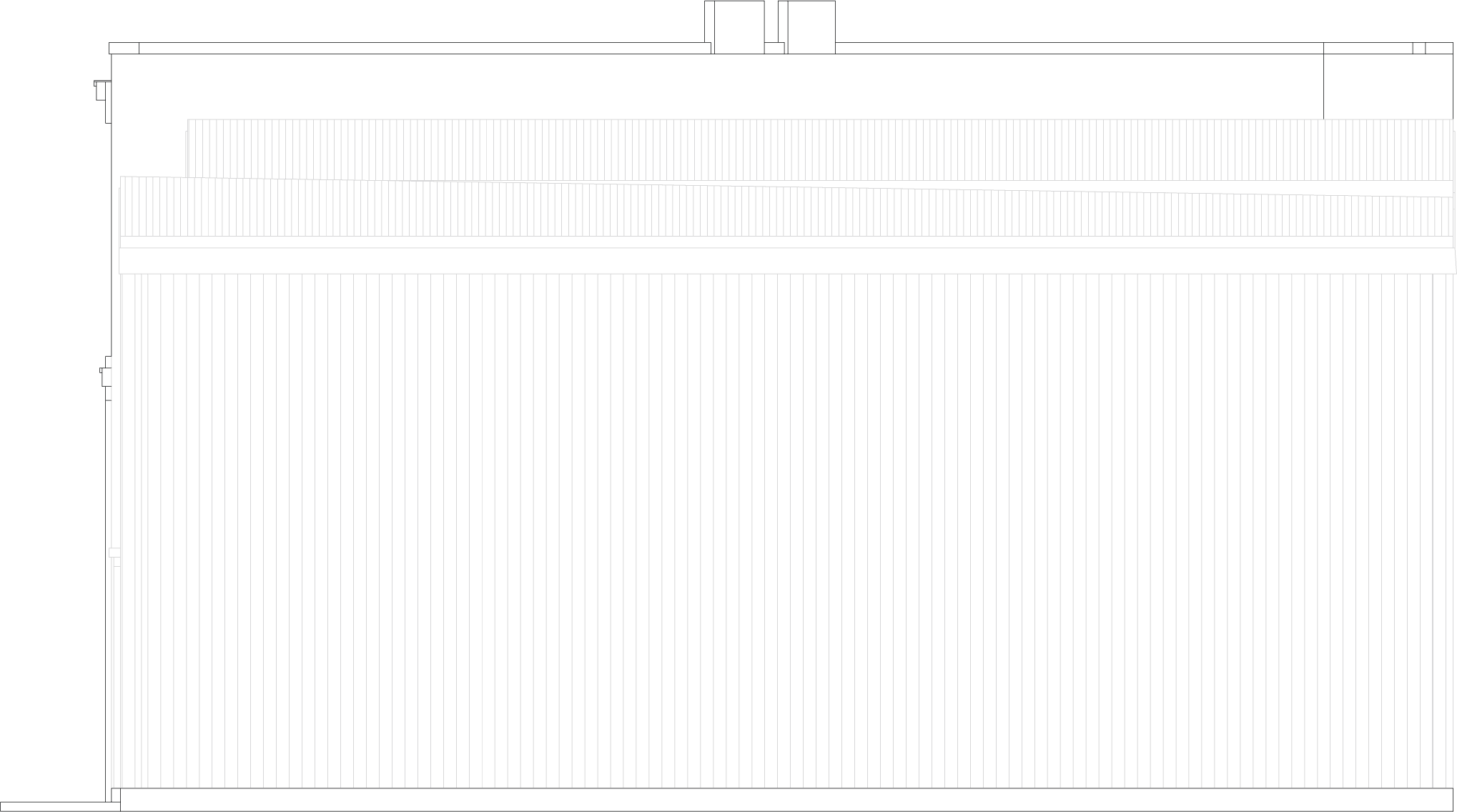
WEST ELEVATION
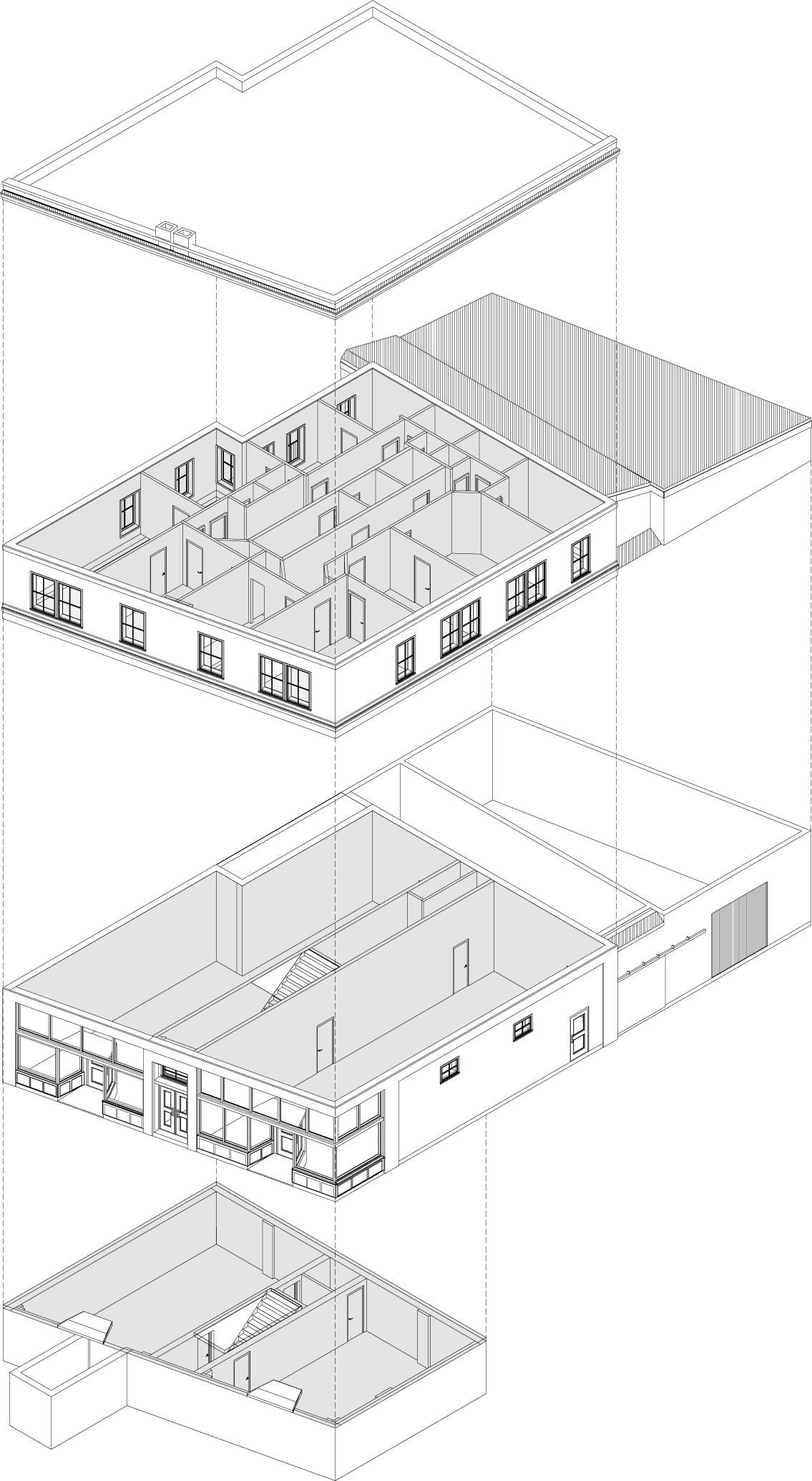
AXONOMETRIC PROJECTION
PROGRAM & SPATIAL HIERARCHY
• Basement: Mechanical, storage, staff access
• Ground Floor: Retail A (Fashion) + Retail B (Coffee) + circulation + back-of-house storage
• Upper Floor: Residential Unit A + Residential Unit B
• Roof: Existing structure preserved; minimal intervention
SECTION OVERVIEW
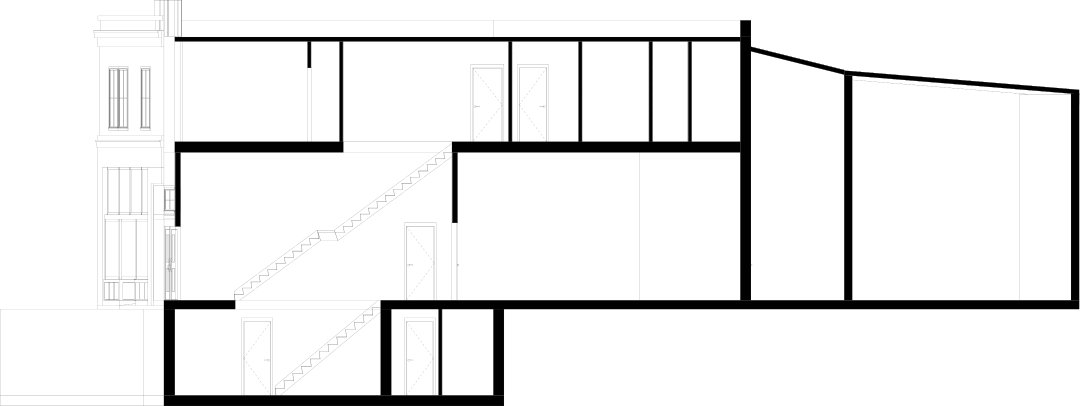
LONGITUDAL SECTION AA
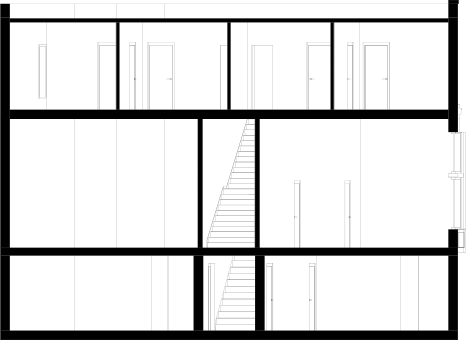
LATITUDINAL SECTION BB
carbon Analysis
Component
Reused
New
Structure
90%
10%
Foundations
100%
0%
Floors
80%
20%
Envelope
40%
60%
Interiors
15%
85%
Embodied Carbon Summary
Adaptive-A10 reduces whole-life emissions through targeted reuse of high-carbon structural elements and performance-driven upgrades.
Key reductions:
• –41% total emissions compared to complete replacement
• –74% structural carbon retained through reuse
• –72% operational energy emissions through envelope + HVAC upgrades
Major contributors:
• Refrigerants remain the dominant lifetime contributor across all scenarios
• Structure becomes nearly negligible in the deep-retrofit scenario
• Enclosure upgrades significantly improve operational energy trajectory
• Minimal demolition avoids ~44 kgCO₂e/m² of unnecessary upfront Impacts
Carbon Reduction Strategy Summary
The carbon strategy for Adaptive-A10 integrates three principles:
1. Preserve
Retain the highest-carbon components (structure, foundation, sub-grade envelope).
2. Reinforce
Upgrade envelope, MEP systems, and air-sealing to reduce lifetime operational emissions.
3. Re-Imagine
Introduce new programmatic elements without replacing carbon-expensive components.
Result
Adaptive-A10 demonstrates how a small-scale commercial building can outperform new construction through strategic reuse, achieving 41% lower whole-life emissions while improving usability and energy performance.
Contact
© Edward Sashkov, 2025.